
reharmonise & restore
Dermal fillers
Also called: hyaluronic acid filler, lip filler, cheek filler, chin and jawline filler.
Dermal fillers at Dr Munroe Clinic restore volume that has been lost with age, or add definition where it was never there. Hyaluronic acid fillers from Teoxane's RHA range are used for the lips, cheeks and mid-face, chin and jawline, and the folds around the mouth. The change is usually visible straight away, with the final result at two to four weeks.



Or scan with your phone
what it treats.
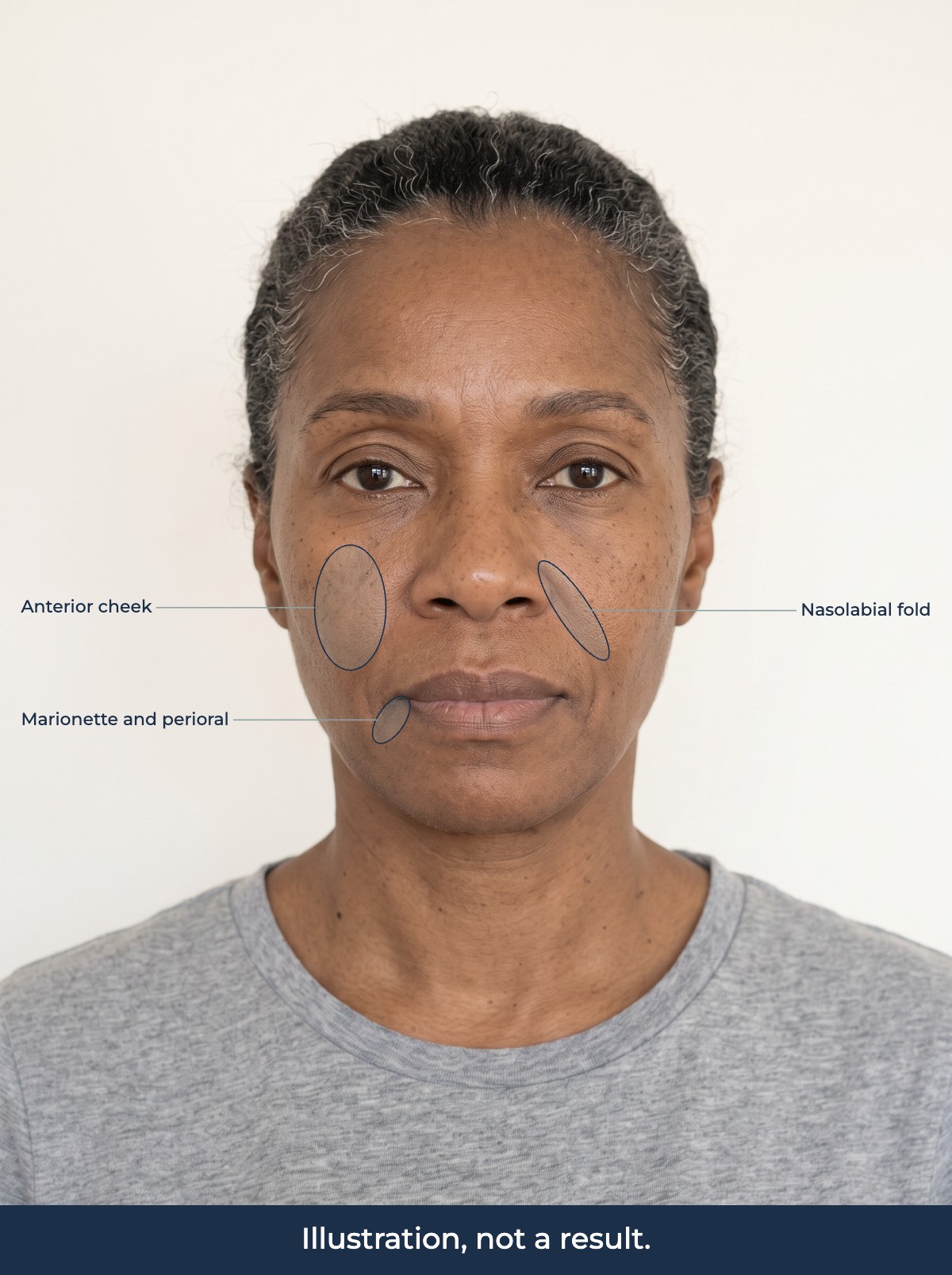
Volume loss is a natural consequence of ageing, whether in the soft tissue or the bone beneath it. With time, the fat pads of the face become thinner and descend, the bone around the eyes, cheeks and jaw gradually changes shape, and the skin has less support beneath it. Rapid weight loss, including with GLP-1 medications such as those used for weight management, can accelerate this. Filler placed at the right depth can restore some of that support, resulting in a more youthful and harmonious appearance.
Lips are treated for shape and proportion rather than size. A chin that sits back can be brought forward, which can change the profile and the line of the jaw. Marionette lines and nasolabial folds can be softened, although they are rarely removed completely.
what it doesn't treat.
Filler restores volume and structure, so it will not improve crepey or dull skin, soften lines caused by expression, or lift heavier, looser skin. Skin regeneration treatments and anti-wrinkle injections address the first two, and significant laxity is a surgical question.
the assessment.
Filler is placed into living tissue that contains arteries, nerves and the openings in the bone (foramina) through which they pass, and their course varies from person to person. An understanding of facial anatomy and its vasculature, including the facial artery and the infraorbital and mental foramina, shapes where filler is placed, at what depth and with which technique. Dr Munroe's surgical training in the head and neck underpins this part of the assessment, which also considers proportion: how a change in one area affects the areas around it, and how much is enough.
what happens on the day.
Following consultation, your concerns are discussed, the risks and side effects are explained and consent is taken before any treatment. Photographs are taken for the clinical record, the treatment areas are marked with you seated naturally, and topical numbing cream is applied; some fillers also contain a local anaesthetic.
Treatment usually takes 30 to 45 minutes, depending on the areas treated, and you can return to your day afterwards.
recovery.
Swelling for 24 to 48 hours is usual and can last a little longer in the lips. Some areas, particularly the lips and under the eyes, are prone to transient swelling in the few days after treatment. Some people bruise and others do not, and this cannot be predicted in advance; when bruising does occur, it usually settles within a few days and can be covered with make-up.
For 24 to 48 hours, avoid strenuous exercise, saunas and extreme heat, and avoid pressing on the treated areas. A firmness that can be felt but not seen is common in the first week or two.
Every treatment carries risks, and these are discussed with you before treatment.
results.
Results are visible straight away, although some of what is seen in the first week is swelling, and the settled result is usually reached by two to four weeks, when it can be reviewed. How long filler lasts varies with the area, the product and the individual, and a range for each area is given at consultation. Treatment is reviewed before any top-up, rather than repeated on a fixed schedule.
who it isn't for.
Treatment is not suitable during pregnancy or breastfeeding, where there is active skin infection at the site, or after a significant reaction to filler in the past. Autoimmune conditions, a history of cold sores around the lips and previous permanent filler in the area are discussed individually.
price.
Prices are available on the price list, and are by area rather than by millilitre.
common questions.
Can filler be dissolved?
Yes. Hyaluronic acid filler can be dissolved if needed, and the clinic holds the reversal agent on site.
What are the serious risks?
Rarely, filler can block a blood vessel, which is why placement, product choice and technique are so important. Dr Munroe is trained in recognising and managing this, and it is discussed in full as part of consent.
Will it look natural?
Results tend to look natural when volume is restored where it has been lost, and in proportion with the rest of the face. That balance is the focus of the assessment.

Clinically reviewed by Dr Tiffany Munroe, MBBS MRCS, GMC 7293952.
Last reviewed October 3, 2026. Next review October 3, 2027.
About Dr Munroethe Munroe Method.


refreshed. refined. you.
Or scan with your phone